Reiki for Pain, Anxiety, and Cancer: Evidence for Curious Skeptics
Living with chronic pain, anxiety, or the challenges of cancer treatment can leave anyone searching for safe, supportive options. Reiki—an energy-based complementary therapy practiced both in person and at a distance—has been studied for its potential to reduce pain, ease anxiety, and enhance quality of life. While Reiki (and Distance Healing) is not a substitute for medical care, several peer-reviewed studies and meta-analyses suggest it may provide meaningful support alongside conventional treatment. In this article, we’ll walk through recent scientific findings, explain what those numbers mean in plain language, and link directly to reputable sources so you can explore the evidence for yourself.
What are Reiki and Distance Healing?
Reiki is a gentle, energy-based therapy that supports the body’s natural healing processes. Practiced both in person and at a distance, Reiki works with the subtle energy running through the body to help reduce stress, ease discomfort, and promote overall well-being. Importantly, Reiki is a complementary technique—not a replacement for medical care—and can be used alongside conventional treatments to support healing and quality of life.
At Whole Self Unity, our mission is to serve individuals in need by offering treatments, classes, and a supportive community for those exploring alternative and complementary therapies. Our professional, expert staff of volunteers and generous donors assure that our services are affordable to those in need, regardless of financial means. We currently focus on supporting women on a cancer journey and their support teams, helping them find safe, low-risk options to complement their medical care and enhance their overall well-being.
Why Look at the Science? (We LOVE skeptics!)
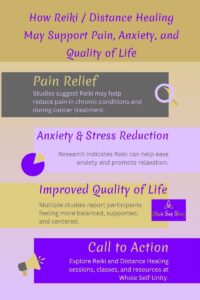
Visual summary of peer-reviewed study findings on Reiki’s potential to support pain relief, stress reduction, and well-being.
It’s natural to be curious—and skeptical—about practices like Reiki and Distance Healing. Scientific research helps separate what is promising from what is anecdotal, giving you a clearer picture of potential benefits. While studies in this field vary in size and design, several peer-reviewed trials and meta-analyses suggest that Reiki may support pain relief, reduce anxiety, and improve quality of life.
Understanding the numbers doesn’t have to be intimidating. Researchers often report findings using terms like effect size (how large the difference is between treatment and control groups in a meta analysis) or confidence intervals (the range in which the true effect likely falls). Meta-analyses combine results from multiple studies to look for patterns across populations. When a study reports that a confidence interval crosses zero, it means the effect is not statistically definitive—but the trends can still offer useful insights. This can be especially useful to researchers to know how to design their next study to offer more clear or better insights. In addition, these trends can help those of us who are skeptical and exploring to better understand how these techniques might be beneficial to us as individuals. Unfortunately, one study cannot prove anything, but each study can reveal little slivers of truth over time.
By examining the research carefully, you can weigh the current evidence for yourself. This section will walk you through a few key studies, explain what the numbers mean in plain language, and highlight both the promise and the limitations of Reiki as a complementary therapy.
Highlighting Evidence: What Studies Show
While no single study can definitively prove Reiki’s effects, research offers glimpses into its potential benefits—small windows into how it might support well-being during stressful times, chronic pain, or cancer treatment. Here, we highlight a few key studies that provide meaningful insight.
1. Liu et al., 2025 – Meta-Analysis on Quality of Life
-
What it studied: This meta-analysis reviewed randomized trials of Reiki for improving self-reported quality of life.
-
What it found: Repeated Reiki sessions (?8) were associated with improved quality of life scores.
-
Plain-language takeaway: Participants who received multiple sessions reported feeling better overall in daily life, suggesting that consistency may matter. As a meta-analysis these results were found by comparing multiple, independent studies that were published across the topic over time.
-
Read the study: Effects of Reiki therapy on quality of life: a meta-analysis of randomized controlled trials.
2. Large RCT in Palliative Cancer Care (Utli / Buyukbayram, 2023)
-
What it studied: Stage III–IV cancer patients received Reiki or standard care to assess pain, fatigue, and analgesic use.
-
What it found: Patients in the Reiki group reported significant reductions in pain, fatigue, and medication use compared with controls.
-
Plain-language takeaway: Reiki may help ease both physical discomfort and mental stress during cancer treatment.
3. ?i?man et al., 2023 – Sham-Controlled Surgical Randomized Clinical Trial
-
What it studied: Abdominal surgery patients were randomized to a. Reiki, b. sham (placebo) Reiki, or c. standard care (no Reiki or placebo), Anxiety, fear, and pain were measured across these three treatment groups.
-
What it found: The Reiki group experienced lower anxiety, fear, and pain than both the sham (placebo) and control (no Reiki or placebo Reiki) groups.
-
Plain-language takeaway: Reiki appears to have effects beyond placebo (which would have shown similar results for the sham or placebo treatment group), at least in this controlled surgical setting.
-
Read the study: The effect of reiki on anxiety, fear, pain, and oxygen saturation in abdominal surgery patients: A randomized controlled trial.

Visual representation of a distance Reiki session, showing energy flow from practitioner to recipient across technology.
I could go on, but these studies establish the possibilities of how best to apply Reiki or Distance Healing to aid in pain relief, anxiety reduction, and to improve quality of life. Energy healing as an addition to medical or mental health issues is non-invasive and presents little risk of harm (that’s a whole other set of studies–let me know if you want more information). When evaluating scientific studies, look for published articles in peer-reviewed outlets, that are recently published, and are frequently cited. For non-researchers these basic guidelines will help you sort out better studies to rely upon when gathering information.
Key points to keep in mind:
-
Effect sizes (ES) indicate magnitude, not certainty that an effect (a difference from the treatment examined across multiple studies)
-
Confidence intervals (CIs) show the plausible range of effects; overlapping CIs suggest that a different study or sample could have somewhat different results.
-
Trends across multiple studies are encouraging but not conclusive; more research is always needed to fully understand who benefits most and under what conditions. This isn’t something particular to Reiki research, but simply the scientific method in action.
-
Reiki is complementary—best used alongside conventional medical care rather than as a replacement.
Supporting Studies & Context
In addition to the core studies highlighted above, several earlier studies provide context and help us understand the evolution of research on Reiki and distance healing. While these are older studies, they can be a way to review the history of this research area (also called a literature review). Certain papers can provide the foundations for methods applied in a study (what population was used, how to test the treatment applied, and how to measure outcomes before and after treatment to calculate results). Here are two older studies that are frequently cited in ongoing research that establish common methods in this literature stream.
Olson et al., 2003 – Phase II Trial in Advanced Cancer Patients
-
What it studied: Patients with advanced cancer received either standard opioid treatment with rest or standard care plus Reiki. Pain, quality of life, and physical measures were tracked over one week.
-
What it found: The Reiki group reported reductions in pain on treatment days and improvements in overall quality of life, though physical measures and medication use did not differ.
-
Takeaway: Even small studies from two decades ago suggested that Reiki could enhance patient-reported well-being during cancer treatment. This paper also serves as an extensive literature review of studies available in 2003, making it a useful starting point for researchers or curious skeptics. Readers who want to explore the evolution of Reiki research can begin here and then follow the subsequent studies that built on this early work.
-
Read the study: Effect of Reiki Therapy on Pain and Anxiety in Adults: An In-Depth Literature Review of Randomized Trials with Effect Size Calculations.
Thrane & Cohen, 2014 – Literature Review with Effect Size Calculations
-
What it studied: This review synthesized multiple randomized trials of Reiki for pain and anxiety, calculating effect sizes to evaluate the magnitude of benefits.
-
What it found: Overall, the literature suggested potential reductions in pain and anxiety, but results were variable and sample sizes often small.
-
Takeaway: This in-depth review highlighted the need for more rigorous research while confirming that earlier studies laid a foundation for later investigations.
-
Read the study: Effect of Reiki Therapy on Pain and Anxiety in Adults: An In-Depth Literature Review of Randomized Trials with Effect Size Calculations
Contextual Summary:
These supporting studies show that Reiki research has been ongoing for decades, and consistent themes—such as reductions in anxiety, support for pain management, and improvements in quality of life—emerge even in smaller or early trials.
By reviewing both recent and older studies, it becomes clear that evidence is gradually building: no single study proves effectiveness, but the body of work provides a reasoned basis for exploring Reiki as a complementary therapy.
Given that the risks of receiving Reiki, distance healing, or other forms of energy healing are low—these practices are non-invasive, do not reduce the effectiveness of ongoing medical treatment, and have no evidence of worsening conditions—there is support for trying them as an AND to regular care, to help you feel better and support your well-being.
Understanding the Numbers: Effect Sizes, Confidence Intervals and Sham Controls (oh my!)
Reading scientific studies can feel overwhelming, but understanding a few key concepts can help you interpret the findings with more confidence.
Effect Size (ES): Effect size measures the magnitude of a difference between groups—how much impact Reiki had in a study. A larger effect size indicates a greater observed difference, but it does not guarantee that the effect is certain or universal. As a guideline:
-
An ES of 0.1–0.3 is considered small, meaning the treatment appears to have some effect, but the real-world impact is likely modest.
-
An ES of 0.5 or greater indicates a larger magnitude of effect across studies, suggesting a more substantial impact.
Confidence Interval (CI): A confidence interval shows the range in which the true effect is likely to fall. If a CI overlaps zero, it suggests that a different sample or study could produce different results. When multiple studies show consistent trends, our confidence that there is a real effect increases.
It’s important to remember that statistical results can disprove relationships but rarely “prove” them outright. Proof requires repeated confirmation across changing situations. However, the right statistical tests can logically show that a result is either highly unlikely or effectively impossible, giving us strong evidence to guide decisions.
Sham or Placebo Controls: Some studies include a “sham Reiki” group to account for placebo effects. If Reiki shows benefits beyond the sham group, it suggests that the practice itself—not just expectation or attention—is contributing to the outcomes.
Putting it together: By looking at effect sizes, confidence intervals, and sham controls, readers can weigh how compelling the evidence is. While science can’t prove anything with a single study, repeated glimpses across multiple studies provide a reasoned basis for exploring Reiki as a complementary therapy alongside conventional care.
Why Reiki Might Be Worth Trying

Symbolic image of hands holding the Earth and connecting in a global circle, representing community, energy healing, and support.
For those navigating chronic pain, anxiety, or cancer treatment, Reiki and distance healing offer a low-risk, complementary approach that can support your overall well-being. Research suggests that regular Reiki sessions may help reduce stress, ease discomfort, and improve quality of life. (Who couldn’t use a little of that kind of help?)
Because Reiki is non-invasive, gentle, and compatible with medical care, it can be explored as an AND—not a replacement—for conventional treatments. Many recipients report feeling more relaxed, centered, and able to cope with challenging symptoms. However, we still recommend talking to your primary provider if you are undergoing significant care and are unsure. We’re here to offer options, not to proscribe treatment!
At Whole Self Unity, we focus on making Reiki accessible. Thanks to generous donors and volunteer support, we provide affordable sessions and classes, helping individuals who might otherwise lack access to complementary therapies. Our mission is to serve women on a cancer journey and their support teams, offering a safe, supportive space to explore Reiki and other energy-based practices.
Practical tips if you decide to try Reiki:
-
Consider starting with multiple sessions, as studies suggest repeated treatments may yield stronger benefits.
-
Keep track of how you feel before and after each session—journaling or reflecting can help you notice subtle improvements. At Whole Self Unity, we also collect this information through intake and follow-up forms for each session. This allows us to share summary results with donors, funders, and volunteers to show how their support is helping people feel better. Individual responses are never shared, only aggregate trends across all recipients.
-
Approach Reiki as part of a holistic self-care plan alongside medical care, rest, nutrition, and emotional support.
Exploring Reiki can be a simple, low-pressure step toward feeling better, supporting both mind and body during challenging times.
Transparency and Next Steps
We believe that curiosity and informed decision-making go hand-in-hand. That’s why we provide direct links to all the studies cited in this article, so you can read the research for yourself and explore the evidence in detail. Understanding the data helps you weigh Reiki as a complementary therapy alongside conventional medical care.
If you’re considering trying Reiki or distance healing, start with small steps: a session, a reflection, and tracking how you feel. Our goal is to make these therapies safe, affordable, and accessible, especially for women on a cancer journey and their support teams. Thanks to generous donors and volunteers, most sessions are available at low or no cost.
You can also join our email list to receive updates on Reiki classes, workshops, and wellness sessions. Whether you’re curious, skeptical, or actively seeking complementary support, learning, exploring, and tracking your experience can help you make the choices that are right for your life.
Resources and Studies Referenced in This Article:
-
Liu K, et al. Effects of Reiki therapy on quality of life: a meta-analysis of randomized controlled trials. Syst Rev. 2025. Open-access link
-
Utli & Buyukbayram, 2023. Stage III–IV cancer patients and Reiki RCT. PubMed link
-
?i?man et al., 2023. Sham-controlled surgical Reiki study. PubMed link
-
Olson et al., 2003. Phase II trial of Reiki in advanced cancer patients. Link to PDF
-
Thrane & Cohen, 2014. Effect of Reiki therapy on pain and anxiety in adults: literature review with effect sizes. Link on ScienceDirect
Conclusion: Exploring Reiki as a Complementary Support
Research over the past two decades suggests that Reiki and distance healing can help reduce pain, ease anxiety, and improve quality of life—especially when used alongside conventional medical care. While no single study proves effectiveness, the growing body of evidence provides a reasoned basis for considering Reiki as a supportive, low-risk option.

Symbolizing love, support, and energy flow, this image reflects the calming and restorative effects of Reiki.
If you’re curious or looking for additional ways to feel better during challenging times, consider exploring Reiki or distance healing sessions. At Whole Self Unity, we offer affordable, accessible treatments, classes, and a supportive community, with a special focus on women on a cancer journey and their support teams.
You can:
-
Book a Reiki session and experience the benefits firsthand–or browse this page to find out more, apply for wellness funds or ready about our practitioners.
-
Join our email list to stay informed about classes, workshops, and wellness sessions OR volunteer and join our team.
- Browse upcoming Event offerings to come to a Reiki share, a monthly workshop, a quarterly online healing, or register for a Reiki class.
-
Explore the studies linked in this article to learn more about the research for yourself.
- Download our FREE guide (PDF) to help prepare for an energy healing session–whether you book with us or another practitioner. This guide helps you set intentions, reflect afterward, and integrate your experience.
Trying Reiki as an AND to regular care may help you feel more relaxed, supported, and empowered in your journey toward feeling better. We hope to meet you soon!

 Reiki I is all about self-healing. In this beginner-friendly class, you’ll learn:
 Your Pathway Beyond Reiki I